
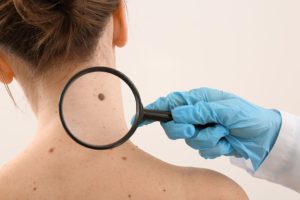
 Australia’s consistent exposure to direct sunlight and its proximity to the sun during summer can expose you to higher levels of ultraviolet radiation, meaning that 2 in 3 Australians will be diagnosed with skin cancer in their lifetime. In this article, the healthcare professionals at Wickham Clinic in Newcastle will cover why early detection is so important, how to spot the early symptoms of melanoma, as well as the signs of basal cell carcinoma and the signs of squamous cell carcinoma. We’ll also explain why getting a professional skin check in Australia is so important. Contact us to speak with a specialist.
Why Early Skin Cancer Detection Matters
Knowing the early signs of skin cancer in Australia is crucial for effective treatment. The survival rate is almost 100% when identified early, but falls sharply once tumours grow more than 4 mm. Early detection means earlier treatment, greatly reducing the chances of surgical complications, disfigurement or death.
Early Symptoms of Skin Cancer
There are a number of different skin cancer types, each with its own symptoms. Look out for:
● Signs of Melanoma in Australia: A new or changing spot that alters in size, colour or shape. It may also appear on areas not regularly exposed to the sun, so check thoroughly.
● Signs of Nodular Melanoma in Australia: A fast-growing, raised and firm lump that may be pink, red, brown or black. It can bleed or crust and develop quickly.
● Signs of Basal Cell Carcinoma in Australia: Often a pearly, pale or red lump, or a dry scaly patch that may ulcerate or not heal, usually on sun-exposed skin.
● Signs of Squamous Cell Carcinoma in Australia: A thickened, red, scaly spot that may bleed or crust, grows faster than basal cell carcinoma, and appears on sun-exposed areas.
ABCDE Melanoma Signs
The ABCDE Melanoma signs refer to a simple, yet very effective method of identifying signs of melanoma in Australia.
● A – Asymmetry: One half of the spot does not match the other.
● B – Border: Edges are uneven, irregular or notched.
● C – Colour: Presence of multiple or uneven colours within the lesion.
● D – Diameter: Larger than 6 mm or increasing in size.
● E – Evolving: Any change in size, shape, colour, or new symptoms such as itching, bleeding or crusting.
When to See a Doctor Immediately
Seek professional medical assistance immediately if you notice that a mole is rapidly changing, looks unusual, or a lesion that crusts, bleeds or does not heal. If you’re uncertain about whether you’re experiencing these symptoms, it’s advisable to seek an appointment anyway. Early detection is crucial to effective treatment. Wickham Clinic in Newcastle offers accessible skin assessments, delivered by trusted professionals.
Why Professional Skin Checks Matter:
Obtaining a skin check in Australia from a professional is a far more accurate test than self-examination. A professional clinician can assess the health of your skin beyond a surface inspection, using a Dermatoscope. They can also track skin changes using total body photography and digital monitoring. High-risk individuals will benefit from scheduled reviews guided by a trusted skin specialist, such as those at Wickham Clinic.
If you have any questions or if you’d like to book an appointment, get in touch with us. Contact us online, or call (02) 4089 2444.